WBZW4A • October 28, 2026
Retailers Are Following Plots, Not People. Peri-Urban India Is Full of Shops Waiting for Customers Who Haven’t Moved In.
The Signal
Retail expansion in tier-2 cities has a blind spot. Around India’s tier-2 and tier-3 cities, farmland is being converted into plotted colonies and commercial complexes far faster than people are moving into them. Many of these colonies stay largely vacant for close to a decade, because the plots are bought to hold, like gold, not to live in. Retail is following the same boards. Shops, franchises and showrooms open at the gates of “upcoming” townships and then wait years for footfall. The land was priced for a future demand. The shop has to pay rent on it today.
What We Know
The vacancy is structural, the sprawl is spreading demand thin, and policy already recognises the problem.
- Census 2011 counted about 11.09 million vacant urban homes, roughly 12% of India’s urban housing stock, according to analysis by the Centre for Social and Economic Progress.
- Land under non-agricultural uses has tripled from about 9.4 million hectares in 1950-51 to about 28.5 million hectares in 2023-24, while net sown area has stayed near 140 million hectares for fifty years, the Ministry of Agriculture’s Land Use Statistics show.
- India’s National Transit-Oriented Development Policy (2017) already names horizontal urban sprawl, longer commutes and stretched infrastructure as problems to solve.
- When the same number of households spreads over a much larger area, each shop needs a bigger catchment, walk-in traffic falls and delivery costs rise per order.
- Converted farmland stops producing crops immediately, but can take years to start producing a neighbourhood, while nearby groundwater recharge falls.
The Pattern — Retail Expansion in Tier-2 Cities Reads Land Price as Demand
Retail expansion in tier-2 India has quietly used land price as a proxy for future footfall. If land is rising, the area must be growing. But land rises because investors expect demand, not because residents have arrived. In sprawled peri-urban belts the two can stay years apart. Vertical, planned density near transport concentrates customers and lets a full street of shops survive. Yet density only helps where real demand exists: a complex with 1,000 shops in a market that supports 400 simply moves the vacancy upstairs.
Our Read
A plot is not a customer. An occupied home is. The retailers who win tier-2 India over the next decade will be the ones who learn to read occupancy, not optimism, Chitrangana says.
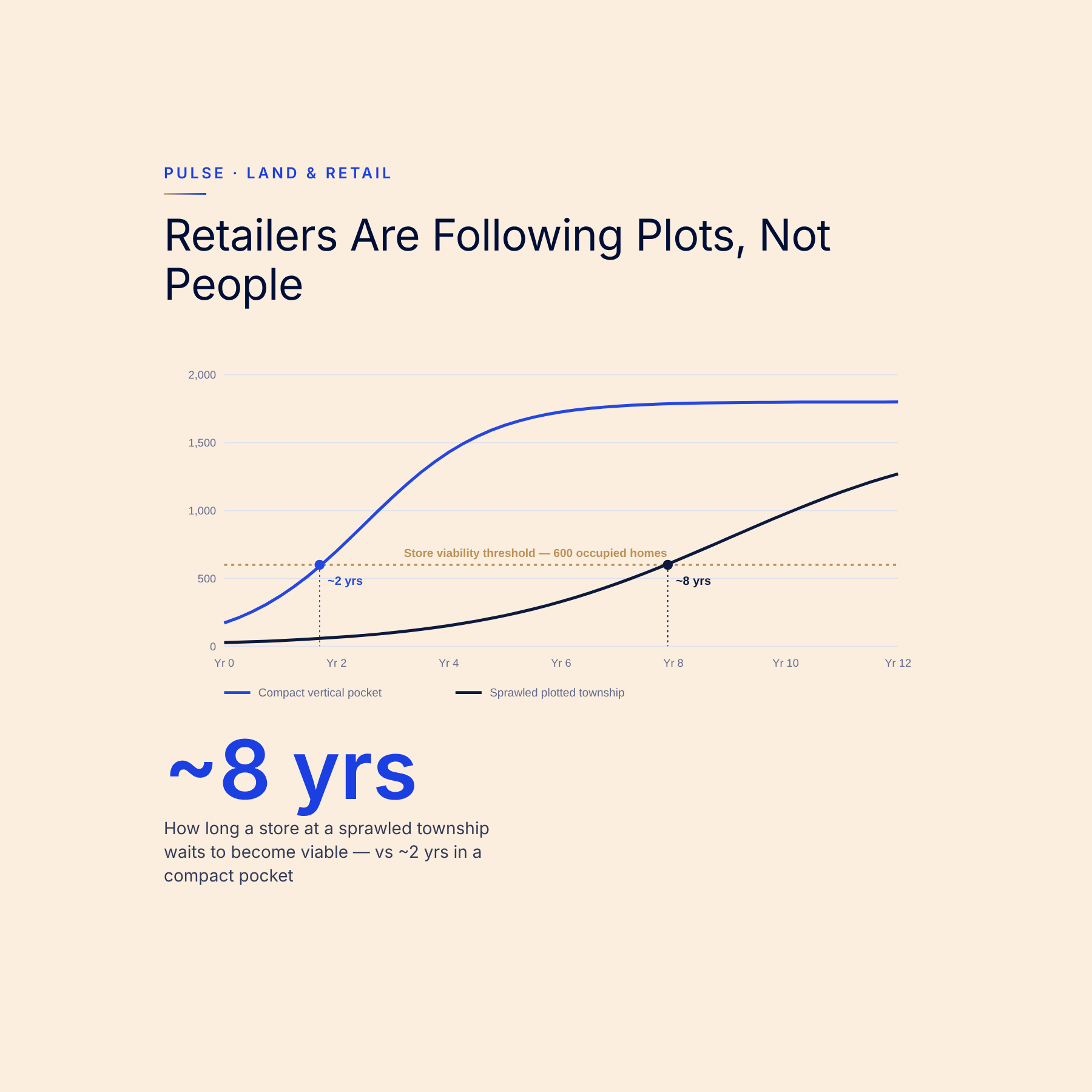
This view comes from Chitrangana’s ongoing study of how India’s land conversion, urban sprawl and agricultural loss connect, and from what we see repeatedly in tier-2 and tier-3 retail markets: stores opened for a catchment that exists on the layout plan but not yet on the street. In Chitrangana’s Catchment Readiness Model, a daily-needs store at the gate of a sprawled 2,000-plot township waits about eight years to reach viability; the same store in a compact, occupied pocket of the same size gets there in about two. We expect occupancy signals such as utility connections, delivery density and lights at night to become a standard input in retail site selection, and compact mixed-use pockets to outperform large plotted townships for footfall.
What This Changes
For any business opening a store on the edge of a city, the question is no longer “is this area developing?” It is “how many households live within a short walk or ride today, and how many moved in last year?” A smaller shop in a dense, occupied pocket will usually beat a large showroom on the empty edge, even at a higher rent. And the discipline India’s cities need, opening the next zone only when the last one is occupied, is the same discipline a growing retail network needs for its next store.
Frequently Asked Questions
Why do new colonies around Indian cities stay empty for so long?
Many plots are bought as a store of value, much like gold, rather than as homes. The investment works without anyone building or moving in, so occupancy can lag sale for many years.
How does this affect retail businesses?
Shops opened in new peri-urban complexes often wait years for enough residents to arrive. Sprawl also spreads customers thinly, so fewer shops can survive on the same street and delivery costs more per order.
Is vertical development the answer?
Partly. Planned vertical density concentrates customers and supports more businesses, but only where real demand exists. Floor space does not create spending power; occupied households do.