# 36384
The Economic Village: Why India’s Next Steady Consumer Market May Be Built Around Clusters, Not Cities
Rural India doesn’t have a demand problem. It has an income-rhythm problem — and village clusters can fix it.
Rural retail in India rises and falls with the farm. Chitrangana’s proposed Economic Village Cluster adds a steady second income. Our models show one 600-job hub adding about ₹4.75 crore a year of local demand, and a path for the rural–urban spending gap to fall from 70% to about 45% by 2036.
not a sales representative.
For FMCG brands, rural retail businesses in India, distributors, agri and food entrepreneurs, and family businesses planning their next move into Bharat. India’s growth story is usually told as a city story. But the next large, stable consumer market may not be a new city at all. It may be a planned cluster of three or four villages, with farmland, a shared employment hub and a fast road to the nearest city. Chitrangana calls this the Economic Village Cluster, and it changes how retail in rural India should be planned.
Rural India spends less than urban India, and its spending swings with the farm season because most households depend on one income engine. Chitrangana’s proposed Economic Village Cluster adds a second engine: three or four villages that keep their farmland and community life, share a hub of low-water, low-land industry such as food processing, handloom and light manufacturing, and stay connected to a nearby city or industrial area. Steady non-farm wages turn seasonal rural demand into monthly, predictable demand. For retail, that creates new opportunities: cluster hub stores, agri-input and output aggregation, B2B supply to processing units, and D2C brands sourced from the cluster. Chitrangana’s model shows one hub of 600 jobs adding about ₹4.75 crore a year of new local demand to a four-village cluster, and projects that wider non-farm income could cut the rural–urban spending gap from 70% today to about 45% by 2036. The condition is strict: jobs must come before housing, or the cluster becomes another vacant township.
Cities Are Expanding. Villages Are Thinning Out. There Is Another Path.
India’s development effort today leans heavily towards new cities, bigger cities and expanding city limits. Villages, meanwhile, are slowly emptying of young people, who leave for jobs and education. The usual assumption is that this is simply the direction of progress: everyone eventually moves to the city.
We think that assumption is incomplete. Cities have high living costs, crowded housing and stretched water and transport. Many families move not because they prefer city life but because the village gives them no second source of income. If a village could offer steady work, good schools, healthcare and a short trip to the city, a large number of people would choose to stay, and some would choose to move back.
What an Economic Village Cluster Actually Is
This is not a proposal to simply add roads and streetlights to villages. Infrastructure without income has been tried. The idea is an integrated model built in three layers.
- Layer 1 — Agriculture stays. Each village keeps its own housing, community spaces and surrounding farmland. Agricultural land is protected, not converted.
- Layer 2 — A shared employment hub. Three or four villages share one hub for activities that use little water and little land: food processing, handloom and textiles, packaging, light assembly, local logistics and repair services.
- Layer 3 — Connectivity. The cluster links by road and transport to the nearest city or industrial area, for specialised jobs, higher education, hospitals and larger markets.
Two more things matter. First, living costs stay at village levels, which is what makes the model attractive to families currently squeezed by city rents. Second, communities keep their own identity, festivals and institutions, while jobs, housing and public services remain open to everyone. Cultural continuity, not separation.
What the Data Says About Rural India Today
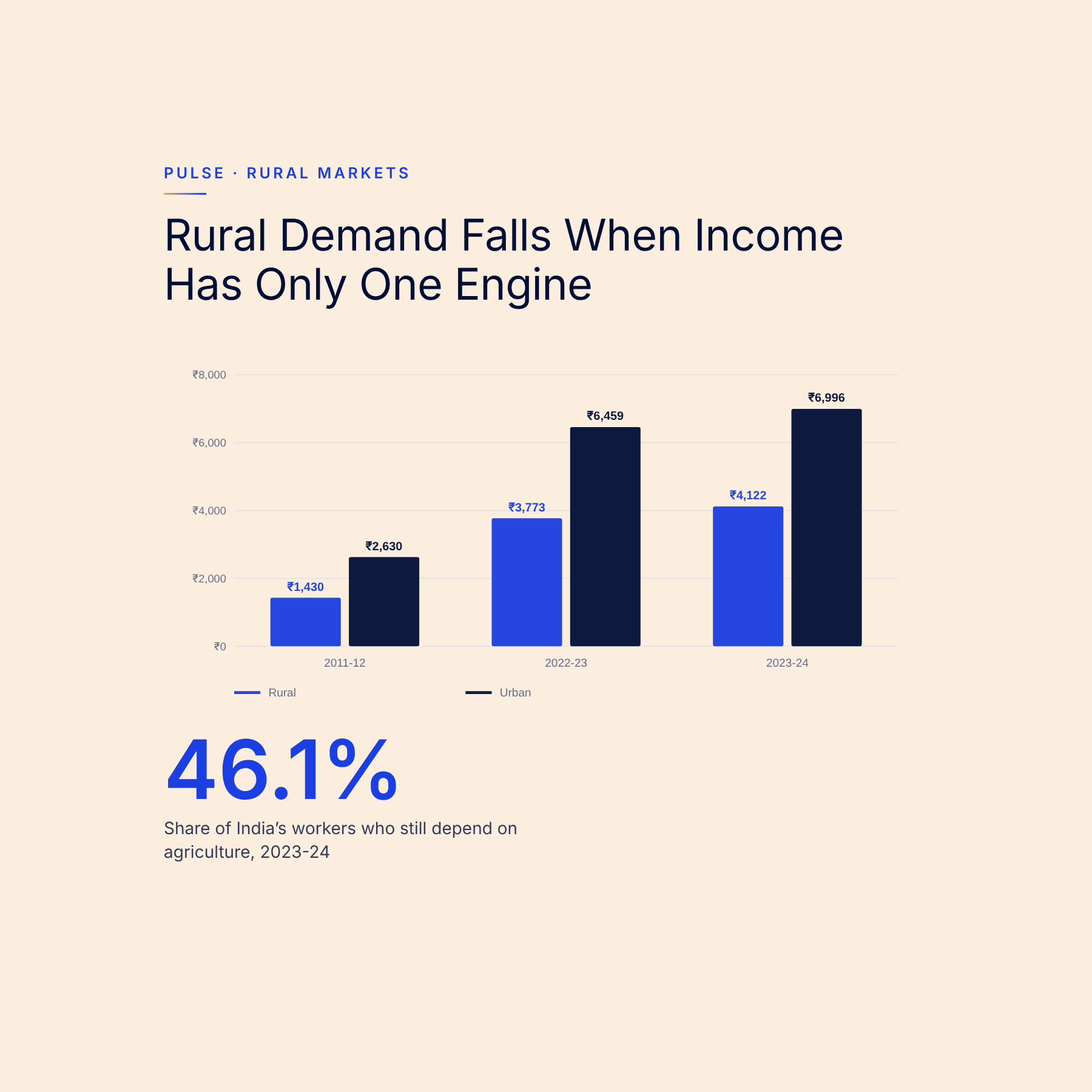
Three sets of official numbers explain why this model matters now. The first is spending. Rural India’s average monthly spend per person has nearly tripled in twelve years, in current prices. It is still well below urban India.
Average monthly per capita consumption expenditure (MPCE), current prices, without imputation. Household Consumption Expenditure Surveys 2011-12, 2022-23 and 2023-24, Ministry of Statistics and Programme Implementation (MoSPI).
The second is work. Contrary to what most people expect, the share of India’s workers who depend on agriculture has gone up recently, not down. More people are leaning on the same farmland for income.
Periodic Labour Force Survey, usual status, all-India, as compiled by the Directorate General of Employment. Almost half of India’s workforce still depends on the farm for a living.
The third is the gap between rural and urban spending, which is closing, but slowly.
How much more an average urban resident spends than a rural one each month. Source: MoSPI, HCES 2023-24.
The gap is closing, but slowly, and rural spending is still fragile. That fragility is the real retail story.
Why Rural Retail in India Needs Stable Income, Not Just More Customers
When most of a village depends on one crop cycle, its spending rises after harvest and falls when the monsoon disappoints or crop prices drop. Retailers and FMCG brands feel this directly. In the April–June 2026 quarter, NielsenIQ reported that rural FMCG volumes fell about 5%, even as modern trade and e-commerce kept growing.
NielsenIQ quarterly FMCG report for April–June 2026, as reported in September 2026.
The two signals point the same way. Rural households want to buy more, and they are increasingly willing to buy through new channels. What they lack is steady income to spend every month. A cluster that adds factory, processing and craft wages beside farm income changes the shape of demand: from seasonal spikes to a monthly salary cycle. Monthly, predictable demand is exactly what organised retail, branded goods, consumer credit and delivery networks need to justify setting up.
Rural India does not have a demand problem. It has an income-rhythm problem. Give a village a second, steady income beside the farm, and it stops being a seasonal market and starts behaving like a monthly one. That is the moment organised retail can stay.
Nitin Lodha, Principal Business Architect & Strategist, Chitrangana
There is also a distribution advantage. A cluster of three or four villages around one hub is far easier to serve than scattered settlements. One aggregation point, one warehouse, one delivery loop. The economics of rural last-mile delivery, which have held back both brands and e-commerce, improve sharply when demand is clustered.
Modelling the Cluster: What One Employment Hub Adds to Local Demand
To show the scale of the change, we modelled a single cluster. The numbers are deliberately conservative and every assumption is stated, so any business can replace them with figures from its own district.
| Model Input | Assumption | Result |
|---|---|---|
| Villages in the cluster | 4 villages × 450 households | 1,800 households |
| Jobs at the shared hub | 600 jobs (food processing, handloom, packaging, light assembly) | 1 in 3 households gains a steady wage |
| Average monthly wage | ₹12,000 | ₹72 lakh of new wages every month |
| Share spent locally | 55% on goods and services inside the cluster | About ₹40 lakh a month, or ₹4.75 crore a year, of new local demand |
| Effect on a working household | Household of 4.5 people at rural MPCE of ₹4,122 spends about ₹18,500 a month | One wage adds roughly 65% to that household’s spending capacity |
- About ₹4.75 crore a year of new, predictable demand — arriving every month — is enough to support two to three well-run cluster hub stores, plus pharmacies, mobile and repair shops, and service providers around them.
- The bigger change is the rhythm. Farm income arrives in two or three lumps a year. Wages arrive every month, which makes consumer credit, subscriptions and regular branded purchases possible.
- All inputs are illustrative assumptions, not survey data. Wage levels, job counts and local spending shares vary widely by district and industry.
Projecting the rural–urban gap
We also projected how fast rural spending could catch up with urban spending. The current-trend scenario simply continues the convergence speed recorded between 2011-12 and 2023-24. The cluster-led scenario assumes that steady non-farm income in rural areas doubles that speed.
Recorded: MoSPI Household Consumption Expenditure Surveys. Projections: Chitrangana convergence model, two scenarios.
- Base: urban MPCE was 1.84 times rural MPCE in 2011-12 and 1.70 times in 2023-24, a convergence of about 0.66% a year.
- Current-trend scenario: the same speed continues. The gap falls from 70% to about 63% by 2030, 57% by 2036 and 46% by 2047.
- Cluster-led scenario: convergence speed doubles as rural non-farm wages spread. The gap falls to about 57% by 2030, 45% by 2036 and 25% by 2047.
- Why it matters: the difference between the two lines is the size of the rural consumer market that steady non-farm income could unlock. It is a planning range, not a forecast.
Five Business Opportunities a Cluster Creates
For entrepreneurs and family businesses thinking about a transition from traditional trade into something new, these are the openings that follow.
| Opportunity | Who It Suits | Why It Works in a Cluster |
|---|---|---|
| Cluster hub store (grocery, FMCG, apparel, mobile, pharmacy under one roof) | Rural retailers, franchise operators, existing wholesalers | One store serves 3–4 villages with monthly-income customers |
| Agri-input and output aggregation (seeds, fertiliser, buying back produce) | Agri traders, FPO partners, agri-tech startups | Protected farmland plus a processing hub creates two-way trade |
| B2B supply to processing and craft units (packaging, raw materials, spares) | Distributors, SME manufacturers | Industry in the hub needs steady local supply |
| D2C brands sourced from the cluster (handloom, processed foods, regional products) | D2C founders, export-focused sellers | Traceable, story-led products with lower production costs |
| Local services (repair, diagnostics, finance, logistics, skilling) | Service entrepreneurs, NBFCs, training providers | Wage earners create demand for services, not just goods |
Where This Can Go Wrong
A useful idea must also be honest about its risks. Four conditions decide whether a cluster succeeds or becomes another empty project.
- Jobs must come before housing. If homes are built before the employment hub works, the cluster turns into the same vacant real estate we see around cities today.
- Industry must be chosen for low impact. Even food processing and handloom use water and produce waste. Units should be selected by actual water use, effluent and land footprint, not by label.
- Upgrading existing villages may beat building new ones. New settlements need land and capital. In many districts, converting existing villages into a cluster will be faster and cheaper.
- India has tried parts of this before. PURA (Providing Urban Amenities in Rural Areas) and the Shyama Prasad Mukherji Rurban Mission, launched in 2016 for 300 rural clusters, both carried similar intentions. The difference we propose is the order: the economic engine first, amenities and housing around it.
Probability and Prediction
These are Chitrangana’s assessments of where rural markets are heading, drawn from consumption data, channel trends and our own field observation. They are judgements to plan around, not guarantees.
| Prediction | Probability | Horizon | What It Means for Business |
|---|---|---|---|
| Non-metro and rural online buying keeps growing faster than metros | High | Ongoing | Brands that build rural distribution now will hold the base later |
| Rural demand stays volatile wherever income depends mainly on farming | High | Ongoing | Plan rural inventory by income rhythm, not by annual averages |
| Food-processing and light-manufacturing hubs grow around rural clusters, driven by state industrial policies | Medium | 5–8 years | Early B2B suppliers and hub retailers capture the first steady wage markets |
| Planned economic village clusters are adopted as a formal development model in at least a few states | Medium–Low | 8–12 years | Slow to start, but large where it happens; worth tracking at state level |
| Rural–urban spending gap narrows to about 57–63% by 2030 (Chitrangana model) | Medium–High | 2030 | Rural becomes the faster-growing half of most consumer categories |
| Where non-farm wages spread, the gap could fall to about 45% by 2036 (Chitrangana model, cluster-led scenario) | Medium | 2036 | Districts with working employment hubs become the best rural markets to enter first |
| Reverse migration to well-connected, low-cost clusters becomes visible | Low–Medium | 10+ years | A long-term upside for rural consumer businesses, not a near-term plan |
What This Means Now
You do not need to wait for a government programme to act on this. The signal to watch is simple: wherever a group of villages gets a working employment hub and a good road, demand will change from seasonal to monthly within a few years. That is where a hub store, a distribution point, a sourcing partnership or a services business should go first.
India does not need to choose between growing cities and living villages. It needs villages that can earn. The businesses that understand this early will not just sell to rural India. They will be part of building its next economy.
Frequently asked
What is an Economic Village Cluster?
Why is rural FMCG demand so volatile in India?
What business opportunities do rural clusters create?
How fast is the rural–urban spending gap in India closing?
Has India tried rural cluster development before?
Wondering where your business sits in the commerce shift?
We map how ready you are today — and design the architecture that keeps you the answer, not the afterthought.
Explore our consulting