R8DU7I • October 31, 2026
Rural Demand Falls When Income Has Only One Engine. The Economic Village Cluster Adds a Second.
The Signal
Rural demand in India keeps being described as the next big consumer opportunity, and then keeps surprising brands with sharp swings. In the April–June 2026 quarter, NielsenIQ reported that rural FMCG volumes fell about 5%, even as e-commerce volumes grew strongly and non-metro online buying grew about three times faster than metros. The appetite to buy is visible. What is missing is steady income to spend every month. Most rural households still depend on one engine, the farm, and their spending rises and falls with it.
What We Know
Rural spending is growing and the gap with cities is closing, but the base is still narrow and seasonal.
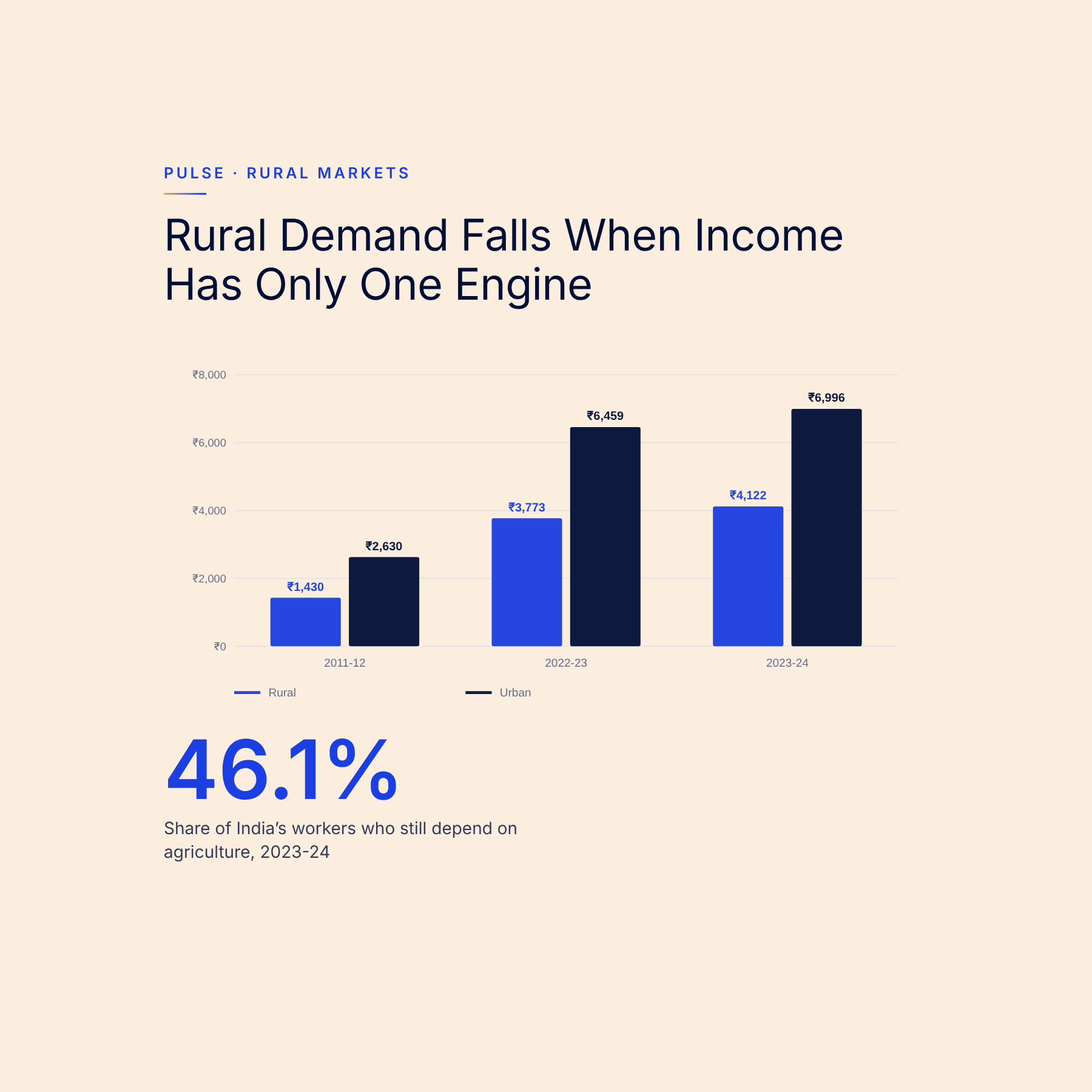
- Average monthly per capita spending in 2023-24 was ₹4,122 in rural India and ₹6,996 in urban India, according to MoSPI’s Household Consumption Expenditure Survey.
- The urban–rural spending gap narrowed from 84% in 2011-12 to 70% in 2023-24, the same survey found.
- The share of India’s workers in agriculture rose from 45.5% in 2021-22 to 46.1% in 2023-24, Periodic Labour Force Survey data show. More people are leaning on the same farmland, not fewer.
- Rural FMCG volumes fell about 5% in April–June 2026, while e-commerce FMCG volumes grew 34.8%, NielsenIQ reported.
- India has tried rural cluster development before, through PURA and the Shyama Prasad Mukherji Rurban Mission, launched in 2016 for 300 clusters.
The Pattern — Infrastructure Without Income
Most rural development has focused on what a village has: roads, power, sanitation, internet. Far less attention goes to what a village earns. Without a second source of income, young people leave for the city, spending stays seasonal, and organised retail cannot justify staying. Chitrangana’s proposed Economic Village Cluster reverses the order. Three or four villages keep their farmland and community life, share one hub of low-water, low-land industry such as food processing, handloom and light manufacturing, and stay connected to a nearby city or industrial area. Living costs remain at village levels, which also makes the cluster a real alternative for families squeezed by city rents.
Our Read
Rural India does not have a demand problem. It has an income-rhythm problem. Add a steady wage beside the farm and a village stops being a seasonal market and starts behaving like a monthly one, Chitrangana says.
This view comes from Chitrangana’s ongoing study of India’s rural development and land use, read alongside consumption and channel data. In Chitrangana’s Cluster Wage Model, one hub of 600 jobs at ₹12,000 a month adds about ₹4.75 crore a year of new local demand to a four-village cluster, and lifts a working household’s spending capacity by roughly 65%. A cluster also fixes rural distribution economics: one hub, one warehouse, one delivery loop serving several villages. The condition is strict. Jobs must arrive before housing does, or the cluster becomes one more vacant township.
What This Changes
For FMCG brands, rural retailers and entrepreneurs moving out of traditional trade, the signal to watch is not population but income rhythm. Wherever a group of villages gets a working employment hub and a good road, demand will shift from seasonal to monthly within a few years. That is where a cluster hub store, an agri-input and produce aggregation point, B2B supply to processing units, or a D2C brand sourced from local crafts and food should be built first. The businesses that arrive early will not just sell to rural India. They will help build its next economy.
Frequently Asked Questions
What is an Economic Village Cluster?
A proposed model of three or four villages that keep their farmland, share one employment hub of low-impact industry, and stay connected to a nearby city or industrial area.
Why does it matter for retail?
Steady non-farm wages turn seasonal rural spending into predictable monthly demand, and clustered villages are far cheaper to serve than scattered ones.
What is the biggest risk?
Building housing before the jobs. Without a working employment hub first, a cluster becomes vacant real estate, the same problem seen around India’s cities today.