 # 33733
How Indian Ecommerce Startups Can Avoid Failure in 2026
The 2026 playbook for founders, built on our original failure-pattern analysis.
How Indian ecommerce startups can avoid failure in 2026 — a practical playbook on retention, capital discipline, and AI, built on our original research.
not a sales representative.
A FOLLOW-UP, NOT A REPEAT
Our original analysis of why Indian ecommerce startups fail covers seven structural mistakes. This piece assumes you’ve read that, and focuses only on what a founder should do differently in the 2026 operating environment specifically — tighter capital, quick-commerce compression, and a higher AI-enabled execution baseline.
Avoiding failure as an Indian ecommerce startup in 2026 is a different exercise than it was even three years ago — not because the seven structural mistakes we identified in our original analysis of why Indian ecommerce startups fail so fast have stopped applying, but because the environment around them has tightened. Capital is harder to raise on a growth story alone, quick commerce has compressed the time a new entrant has to prove a category, and AI has quietly raised the baseline of what “competent execution” looks like. This is the practical follow-up: what a founder should actually do differently in 2026, not just what to avoid.
Read alongside the original piece, the two form a diagnosis and a plan — the first explains the failure pattern, this one is the playbook for standing on the other side of it.
What Has Actually Changed Since the Original Failure Pattern
Three shifts matter most. First, funding has moved from rewarding growth-at-any-cost to demanding a visible path to unit economics within the first serious raise — a startup burning cash to show scale without repeat behaviour underneath it is a much harder sell than it was a few years ago. Second, quick commerce has taken over the impulse and convenience layer of Indian ecommerce almost entirely, which means a new D2C entrant competing purely on availability and speed is competing with businesses that have already won on those exact terms. Third, AI-enabled operations — from WhatsApp-based support to inventory forecasting — have quietly become the baseline a well-run competitor operates at, which means a founder who skips this layer isn’t just missing an upside, they are running slower than the market average without realising it.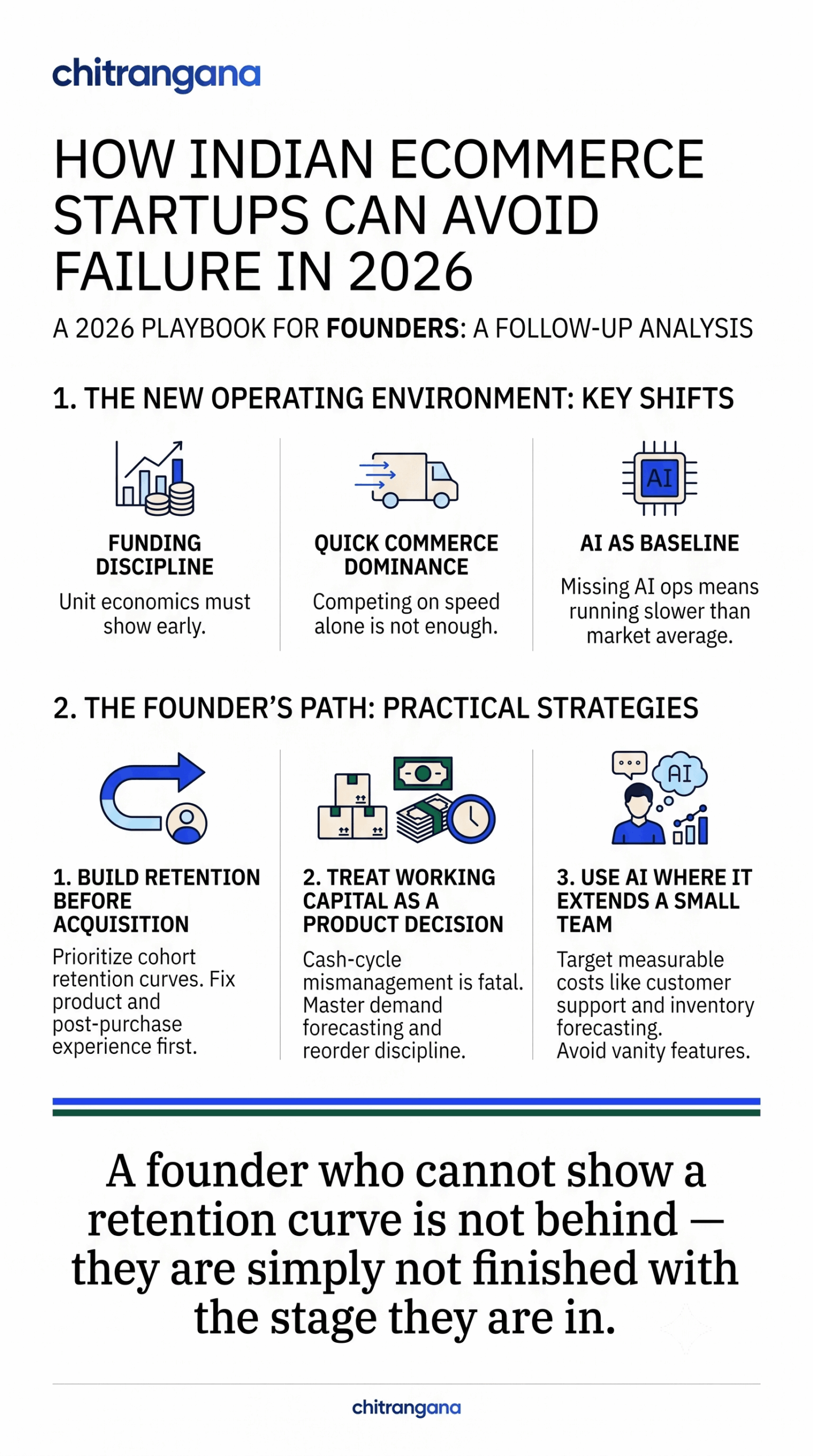
| Shift Since the Original Pattern | What It Means for a Founder Now |
|---|---|
| Funding discipline | Unit economics must show early, not “after scale” |
| Quick commerce dominance | Competing on speed alone is no longer a viable entry wedge |
| AI as baseline | Skipping AI-enabled ops means running slower than the market average |
Build Retention Before You Build Acquisition
The single clearest lesson from the last few years of Indian D2C is that acquisition spend without a repeat-purchase mechanism underneath it produces a business that looks alive on a dashboard and is dead in its unit economics. Before increasing marketing spend, a founder should be able to show a cohort retention curve — even a rough one — that holds at each stage past the first purchase. If that curve doesn’t exist yet, the honest next step is fixing the product and post-purchase experience, not buying more traffic to point at it.
Treat Working Capital as a Product Decision, Not a Finance Afterthought
Inventory-heavy and COD-heavy categories fail as much from cash-cycle mismanagement as from any product or marketing problem — money tied up in unsold stock or awaiting COD collection is money that cannot fund the next production run, and this compounds quickly in a thin-margin business. Demand forecasting and reorder discipline are not backend technicalities; they are as central to survival as the product itself, and founders who treat them as an operations detail to solve “once we scale” typically discover the cash problem before they ever reach that scale.
A founder who cannot show a retention curve is not behind — they are simply not finished with the stage they are in.
Use AI Where It Extends a Small Team, Not Where It’s a Vanity Feature
The founders getting real value from AI in 2026 are not the ones with the most AI features — they are the ones who used it to replace a specific, measurable cost their small team could not otherwise absorb, most often customer support and inventory forecasting. Our broader breakdown of where AI in ecommerce actually pays off, and the real examples from Indian D2C brands that follow that pattern, are worth reading before committing budget to any AI vendor pitch — the category your business sits in usually tells you which use case to prioritise first.
Choose One Distribution Channel Deeply Before Adding a Second
Startups that split early attention across a website, a marketplace presence, and quick-commerce listings simultaneously rarely build deep enough proof in any single channel to know what is actually working. The more defensible sequence is proving unit economics and repeat behaviour on one channel first, then expanding — because a second channel added before the first is understood usually just spreads the same structural problems across a wider surface.
Bring In Outside Judgment Earlier, Not Later
Founders routinely wait until a problem is already visible — a stalled cohort curve, a cash crunch, a channel that isn’t converting — before seeking outside business consulting or ecommerce-specific advisory input. The businesses that avoid the worst outcomes tend to bring in structured outside judgment while the numbers still look fine on the surface, when there is still time to redirect course without a crisis forcing the decision.
A 2026 Readiness Checklist for Founders
Four questions are worth answering honestly before the next funding round or the next scale-up decision. Does a repeat-purchase cohort curve exist and hold, even roughly, past the first two purchases? Is there enough working capital runway to survive a forecasting mistake without a fire sale or a missed payroll cycle? Has the business proven itself on one distribution channel before spending to expand into a second? And is there a named outside advisor or consulting relationship in place before a problem forces the search for one? A founder who can answer yes to all four is in a genuinely different position from one relying on optimism and a growing top-line number — and that difference is, in the end, the entire argument of this piece.
Wondering where your business sits in the commerce shift?
We map how ready you are today — and design the architecture that keeps you the answer, not the afterthought.
Explore our consulting