 # 33728
Artificial Intelligence in Ecommerce: Real Examples from Indian D2C Brands
Five Indian D2C categories where AI in ecommerce already earns its cost.
Real ai in ecommerce examples from Indian D2C brands, organised by category — beauty, WhatsApp commerce, perishables, apparel, and catalogue content.
not a sales representative.
The clearest evidence of what AI in ecommerce actually delivers is not in vendor case studies — it is in how Indian D2C brands, operating on thin margins and real cash-on-delivery risk, have quietly built AI into the parts of the business that would otherwise need far more people. These examples are grounded in the public, structural realities of each category — perishable logistics, catalogue scale, WhatsApp-first support — rather than vendor claims, because the pattern matters more than the brand name.
Search “AI in ecommerce examples” and most results are generic — Amazon’s recommendation engine, a chatbot demo, a pricing dashboard. None of it answers the real question an Indian founder or operator has: what does this look like in a business that looks like mine? This article works through five categories of Indian D2C brand where the operating model itself explains why AI earns its cost, and what a founder building a similar business should take from each.
HOW TO READ THESE EXAMPLES
Each category below is grounded in the public, structural realities of that business model — perishability, WhatsApp-first support, COD risk, catalogue scale — not in claims about any single brand’s internal technology. The pattern is the takeaway, not the name.
Why Indian D2C Brands Are the Clearest Place to See AI in Ecommerce Working
Large marketplaces can absorb inefficiency that a D2C brand cannot. A D2C business typically owns its own inventory, its own customer relationship, and its own margin — which means every rupee spent on a support call, an overstocked SKU, or a fraudulent cash-on-delivery order comes directly out of a much thinner pool than a marketplace seller enjoys. That pressure is exactly why the clearest, least hyped applications of AI in ecommerce tend to show up first in D2C, not in enterprise retail: the businesses adopting it are not doing so for a press release, they are doing so because the alternative is hiring people they cannot yet afford.
Personalisation and Discovery in Beauty and Personal Care
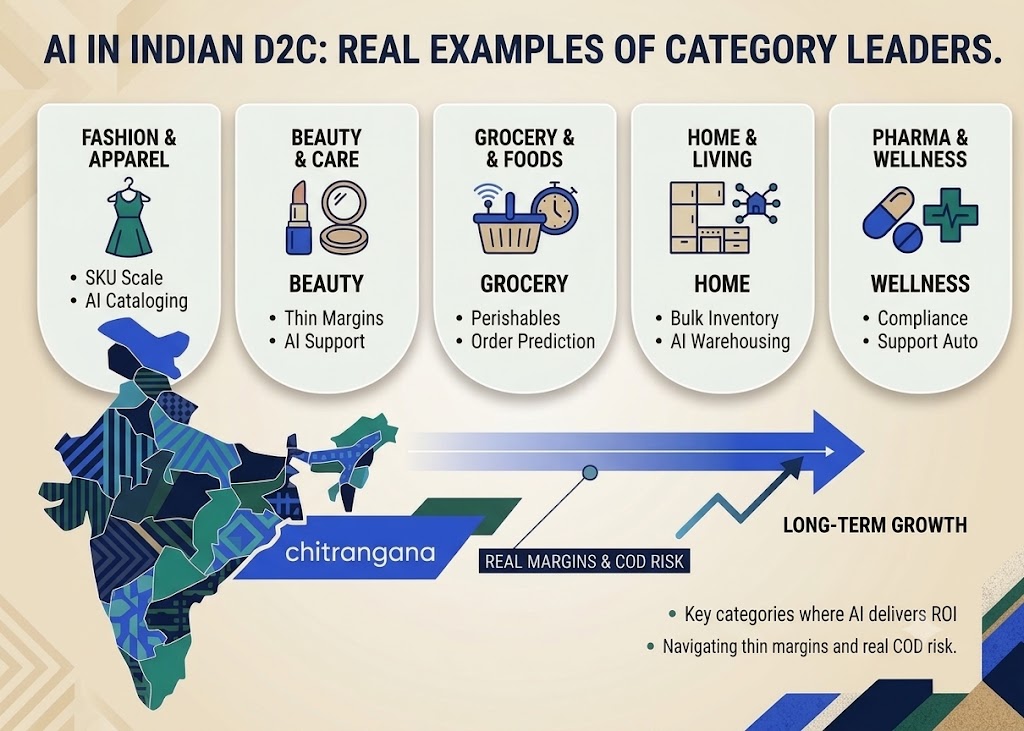
Beauty and personal care is one of India’s most crowded D2C categories — brands such as Mamaearth, Sugar Cosmetics, and Wow Skin Science compete for the same shopper’s attention with overlapping catalogues of serums, cleansers, and colour cosmetics. In a category this saturated, a shopper who cannot quickly find the right shade or skin-type match simply leaves. This is precisely the structural condition where recommendation and discovery models earn their keep: the catalogue is large enough to need machine-assisted matching, and the margin per unit is high enough to justify the investment, unlike a category with only a handful of SKUs.
Conversational Commerce Where WhatsApp Is the Storefront
For D2C brands selling into tier-2 and tier-3 India, WhatsApp often functions as a second storefront rather than a support channel bolted onto a website. Order confirmations, delivery updates, sizing questions, and return requests move through WhatsApp because that is where the customer already is, and a language-model-backed assistant handling that volume directly replaces headcount that would otherwise need to scale linearly with order volume. This is the single most transferable lesson for a founder building a new D2C brand today: before investing in a website chatbot, check where your customers are actually messaging you from, because the AI investment should go there first.
Demand Forecasting Where the Product Cannot Wait
Categories built on perishable or time-sensitive inventory — fresh meat and seafood D2C brands such as Licious, or fast-turnaround categories like flowers and fresh produce — operate under a constraint that dry-goods D2C brands do not face: unsold stock is not markdown inventory, it is a write-off. That single fact makes demand forecasting a structural necessity rather than an optimisation nice-to-have, because the cost of a bad forecast is immediate and total, not spread out over a clearance sale. Any founder entering a perishable or fast-moving category should treat forecasting infrastructure as a launch requirement, not a phase-two upgrade.
Fraud and COD Risk in High-Return Categories
Apparel and footwear D2C brands carry two compounding cost problems that categories like beauty rarely see at the same scale: high cash-on-delivery share and high return rates driven by fit uncertainty. A model that scores incoming orders for non-collection or fraud risk — flagging addresses and order patterns worth a confirmation call or a prepaid-only offer — directly reduces reverse-logistics cost, which in apparel can otherwise consume a meaningful share of gross margin on every order that comes back. This is a category where the return on a fairly simple risk-scoring model is unusually fast to prove out.
Content and Catalogue Generation at SKU Scale
Brands adding new colourways, sizes, or seasonal variants every month — common across cosmetics and fast-fashion D2C — face a catalogue-content bottleneck that a small content team cannot keep pace with by hand. Generative drafting of product descriptions and size guidance, always followed by human editing rather than direct publishing, is where this category of brand gets real throughput gains without the thin, repetitive-sounding catalogue pages that damage both shopper trust and search visibility when AI output goes out unedited.
| Category | Structural Cost | Where AI Earns Its Cost |
|---|---|---|
| Beauty & personal care | Catalogue saturation, shade/fit matching | Personalisation and discovery |
| Tier-2/3 D2C | Support volume via WhatsApp | Conversational commerce |
| Perishables (meat, produce) | Unsold stock is a total write-off | Demand forecasting |
| Apparel & footwear | High COD share, high returns | Fraud and risk scoring |
| Fast-fashion / cosmetics | Monthly SKU/catalogue growth | Content generation (human-edited) |
What This Means If You’re Building a D2C Brand Today
AI investment earns its cost fastest when it maps directly onto a structural cost the business model already carries — not because “competitors are doing AI.”
Before adopting any of the applications above, the more useful exercise is identifying which structural cost your category carries most acutely, in the way described in our broader breakdown of AI in ecommerce and where it actually pays off, and building toward that first. It is also worth reading alongside our analysis of what is actually driving the rise of D2C brands in India, since the operating pressures that make AI valuable are the same ones shaping how these brands scale in the first place.
Wondering where your business sits in the commerce shift?
We map how ready you are today — and design the architecture that keeps you the answer, not the afterthought.
Explore our consulting